The "best meal planning app" list that ranked itself #1
If you've searched for meal planning apps recently, you've probably landed on a blog post written by one of the apps. Ranking themselves first, naturally. Ollie publishes "Best Meal Planning Apps" articles where Ollie is the top pick. Fitia does the same thing. It's content marketing dressed up as journalism.
We're not going to do that. Instead, let's talk about something none of those listicles mention: where the recipes actually come from.
The closed database problem
Most meal planning apps don't tell you this: they all pull from the same kind of source. A fixed, internal recipe database. Ollie has one. Samsung Food has 240,000 recipes in theirs. Mealime has a curated set. Eat This Much has about 5,000.
These databases have a ceiling. Once you've cycled through them, you start seeing the same meals. Users notice. App store reviews for every major meal planner include some version of "the recipes got repetitive after a few months."
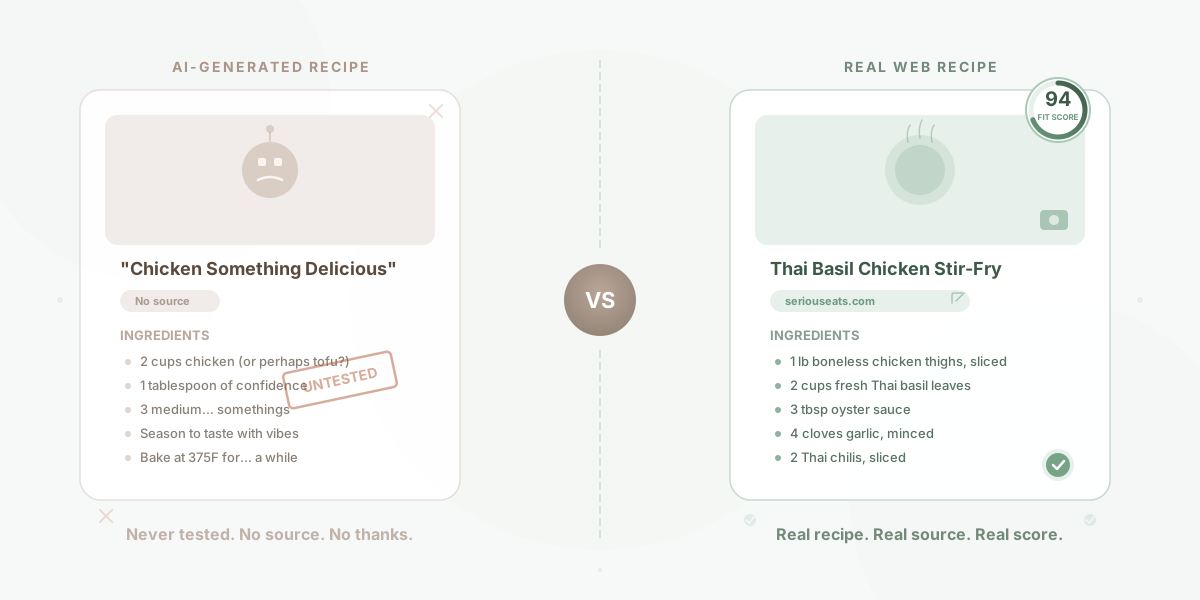
The other approach is worse: AI-generated recipes. As more apps bolt large language models onto their recipe features, they're generating recipes that have never been tested by a human, never been photographed, and never been cooked in a real kitchen. Some of these recipes don't even work. Missing steps. Impossible ratios. Hallucinated ingredients.
There's a word for this: AI slop. And it's becoming the default in meal planning.
Eatgent doesn't have a recipe database
Eatgent takes a different approach entirely. When you tap "Plan My Week," our AI doesn't pull from a fixed library. It searches the real web: food blogs, recipe sites, cooking publications. Then it evaluates what it finds against your specific profile.
Every recipe in your plan:
- Was written by a real person. A food blogger, a cookbook author, a home cook who tested it and published it.
- Has a source you can visit. You can click through to the original recipe page. See the photos. Read the comments. Check the reviews.
- Was scored against your preferences. Our fit scoring system evaluates each recipe against your dietary restrictions, cuisine preferences, skill level, and time constraints, then ranks it on a 0-100 scale.
- Drives traffic to the person who created it. When you tap a recipe, you go to the original creator's site. We don't scrape, rehost, or strip attribution. The food blogger who spent hours developing, testing, and photographing that recipe gets the visit.
No closed database. No AI-generated filler. Real recipes from real sources, matched to your real life.
We find recipes. We don't steal them.
Most recipe apps treat content creators as a supply chain. They scrape recipes, strip them from their source, and display them inside the app. The creator gets nothing. No traffic, no ad revenue, no credit beyond a small-print attribution link that nobody clicks.
Eatgent works the other way. We're a discovery engine, not a content warehouse. Our AI searches the web, evaluates recipes against your profile, and builds your plan. But every recipe links back to the original source. When you cook the Thai basil chicken that scored 94 for your profile, you're visiting the food blog where someone actually developed it.
This isn't charity. It's a better model. Content creators keep publishing great recipes because they get traffic and revenue from their work. Eatgent users get access to an ever-growing pool of tested, real-world recipes instead of a stale database. Both sides win.
The closed-database apps can't say this. They've already taken the recipes. The AI-generated apps can't say it either, because there's no creator to credit. Eatgent is the only meal planner where using the product actively supports the people who make the recipes possible.
Why recipe source matters more than you think
When a meal planner pulls from a closed database, three things happen:
1. Variety has a hard limit. A database of 5,000 recipes sounds like a lot until you factor in your dietary restrictions, ingredient preferences, and the recipes you've already seen. The effective pool shrinks fast.
2. You can't verify quality. Where did this recipe come from? Who tested it? How many people have cooked it? With a closed database, you're trusting the app's editorial judgment without any transparency.
3. Recipes go stale. Food trends evolve. New techniques emerge. A static database from 2023 doesn't know about the cooking trends of 2026. The web does.
With Eatgent's web-search approach, the recipe pool has no ceiling. New recipes published yesterday are candidates for your plan today. And because every recipe links back to its source, you always know where it came from.
Fit scoring: the part nobody else does
Finding recipes is half the problem. The other half is knowing which recipes are right for you.
Most apps handle personalization with basic filtering: exclude allergens, match a diet type, done. That's the bare minimum. It doesn't tell you whether a recipe is actually a good fit for your household.
Eatgent's fit score evaluates every candidate recipe across multiple dimensions:
- Does it match your dietary restrictions?
- Does it align with your cuisine preferences?
- Is the cooking complexity right for your skill level?
- Does the prep time work for the day of the week?
- Does it introduce variety relative to what you've eaten recently?
- Does it reuse ingredients from earlier in the week to reduce waste?
The result is a transparent 0-100 score. Not a black box. Not "we think you'll like this." A score you can see and understand, attached to a real recipe you can verify.
No other meal planning app does this.
Week-level planning vs. day-level suggestions
The "best of" listicles also skip this: most meal planners don't actually plan your week. They suggest individual meals that you drag onto a calendar.
Ollie generates a weekly plan, which is a step up. But it's pulling from that closed database, so it's constrained by what's in the library. Samsung Food gives you a drag-and-drop calendar, meaning you're doing the planning yourself. Mealime generates a few recipes at a time. Plan to Eat is a recipe organizer, not a planner.
Eatgent plans sequentially, day by day, with the full week in context. When it picks Wednesday's dinner, it already knows what you're eating Monday and Tuesday. It balances proteins so you're not eating chicken four nights in a row. It varies cuisines so you're not stuck in a rut. It manages cooking complexity so you're not doing elaborate meals every night.
This is week-level coherence. It's the difference between seven good recipes and an actual meal plan.
What about the apps the listicles recommend?
Quick rundown:
Ollie has strong family features and good marketing. But it uses a closed recipe database, offers no transparency into how it picks recipes, and charges $10/month. If you're a family with young kids and picky eaters, Ollie is built for you. If you want to discover real recipes from across the web, scored and matched to your profile, it's not.
Samsung Food is free and has a massive recipe library. But it's a recipe organizer with a calendar, not an AI planner. You're doing the work of deciding what to cook and when. If you want a place to save recipes and plan manually, it's solid. If you want the planning done for you, it's not that.
Eat This Much is excellent for hitting macro targets. If your primary goal is "1,800 calories with 140g protein," it's the best tool for the job. But the recipes are functional, not inspiring, and the database is small enough that it gets repetitive with many dietary exclusions.
Mealime is simple, fast, and good for weeknight dinners. But it has no AI personalization, limited to 2/4/6 servings, and hasn't meaningfully updated its feature set in years.
Each of these apps is good at a specific thing. None of them search the real web, score recipes against your profile, or plan with week-level coherence.
The question to ask any meal planning app
Next time you evaluate a meal planner, ask one question: where do the recipes come from?
If the answer is "our database," ask how big it is, how often it's updated, and what happens when you've seen everything in it.
If the answer is "AI generates them," ask who tested them and whether you can find the original source.
If the answer is "the real web, scored against your profile, with a source link for every recipe"... that's Eatgent.
Try Eatgent free for 7 days. Real recipes, real sources, planned for your real week.